
Contents
The cable is the part that breaks most often and gets the least attention when it is replaced. Yet it has a real say in how fast your phone charges and how long the charging port survives.
Why a cheap cable charges more slowly
A charging cable is not a simple wire. High power needs conductors of sufficient thickness, proper shielding and, on fast USB-C connections, a small chip that tells the power adapter what the cable can handle. If that chip is missing or the conductors are too thin, the adapter plays safe and negotiates the lowest step. Your 30 watt charger then delivers maybe 7 watts, and you wonder why the phone needs all night.
That is the most common reason when someone believes the battery has suddenly gone bad. Before you consider a battery replacement, try a different cable.
What can actually go wrong
- Loose contact and heat: Badly fitting plugs create contact resistance. The plug gets warm, and that is a warning sign.
- Mechanical damage to the port: Plugs with sloppy tolerances widen the port over time. Eventually no cable sits firmly any more and a charging port repair is due.
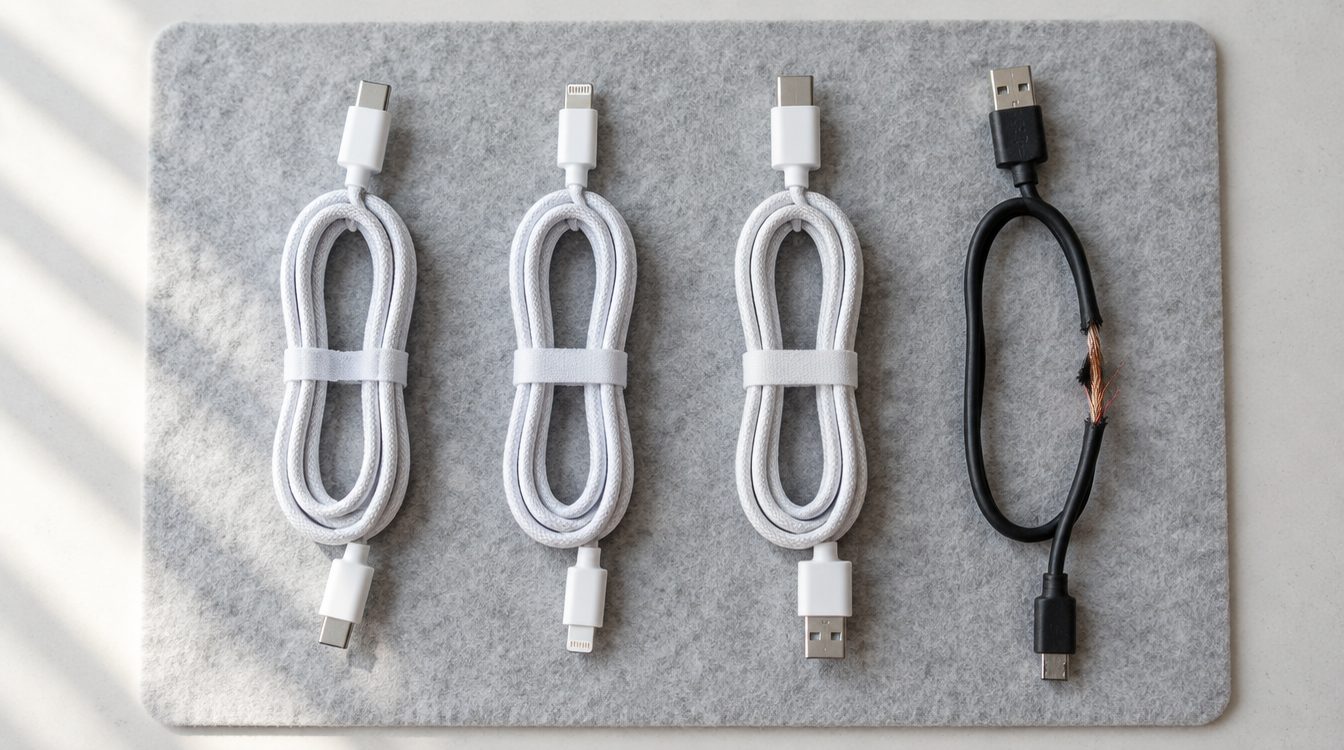
- Cable break at the plug: Without strain relief the cable bends at exactly the same spot every time. After a few weeks it is finished.
A modern phone has a protection circuit and is not easily damaged by a poor cable. The realistic danger is therefore less the dramatic scenario than the creeping one: slow charging, a worn port, constant replacement purchases.
How to recognise a good cable
Look for a clear power rating in watts or amps, proper strain relief on both plugs and a braided or thick jacket if the cable travels in your bag every day. With USB-C you should know whether the cable only charges or also transfers data, because many cheap models can only do the former. Anyone who backs up their phone on a computer regularly needs a cable with data lines. Suitable cables are listed under Power and cables.
Length and everyday use
Two metres by the bed, half a metre at the power bank, a short one in the car: the right length saves more nerves than a few extra watts. And a spare cable in your rucksack is cheaper than an emergency purchase at the station. For the car, fixed solutions are worth a look, and there is more on that in our article on charging and mounts in the car.
Conclusion
Saving on the cable usually means buying it twice. A solid cable with a clear power rating and strain relief costs only a little more, charges at full speed and protects the port, which, unlike the cable, cannot be replaced for a few francs.
Frequently asked questions
Can a cheap cable destroy my phone?
My phone suddenly charges slowly, is the battery dead?
How do I know whether a cable also transfers data?
Why does my cable always break at the plug?
Related to this article
Instant quote in 2 minutes, payout within 24 hours after inspection. Or buy certified refurbished with a 1-year warranty and 14-day returns.