
Contents
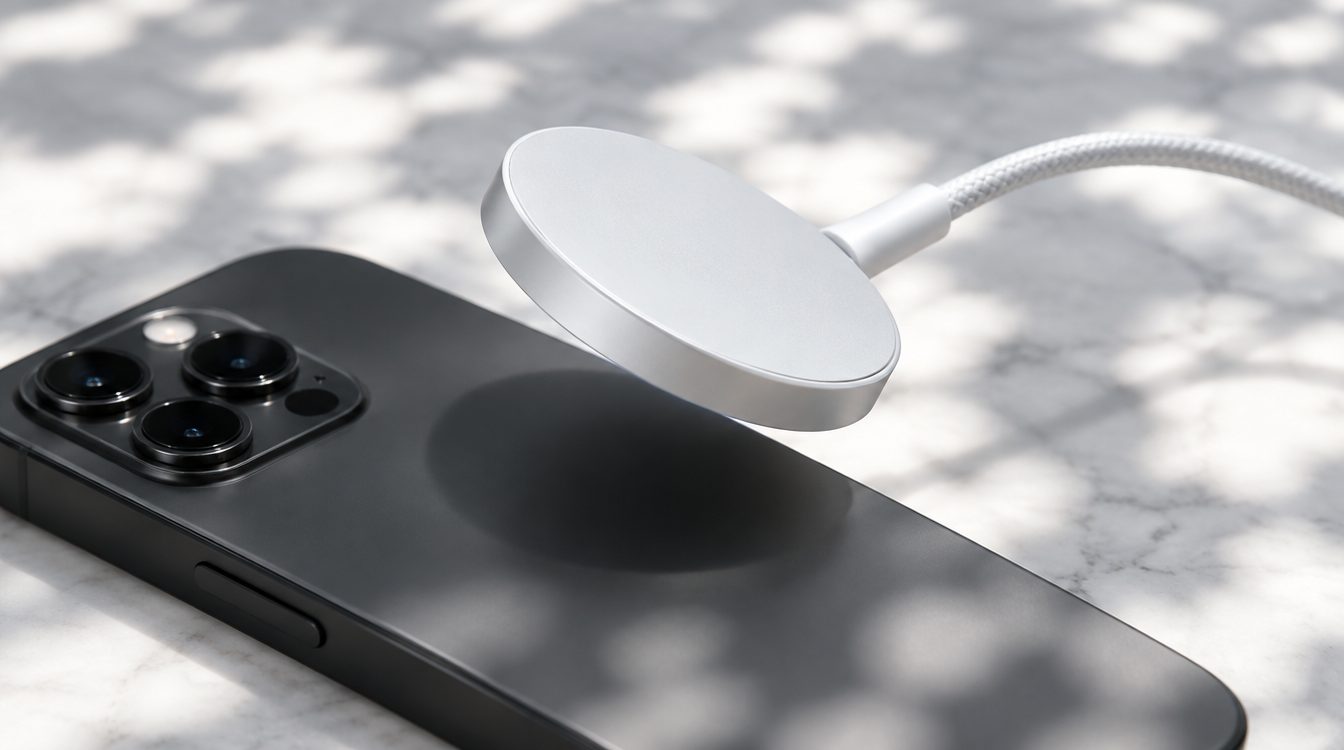
Since the iPhone 12, every iPhone has a magnet ring around the charging coil. Apple calls this MagSafe, and the name is slightly misleading: it is not only about charging, but above all about accessories sitting in the right place by themselves.
What MagSafe does technically
The ring centres the charging coil over the counterpart coil to the millimetre. That is the actual trick, because wireless charging loses energy as soon as the coils are offset. On a normal Qi charging pad you put the phone down somehow and hope. With MagSafe it snaps into place, always sits the same way and therefore charges more reliably and more coolly.
On top of that, the iPhone uses the ring to recognise which accessory is attached. That is how it knows whether a charging case, a card holder or a charging station is currently connected.
How fast does MagSafe really charge?
Wireless stays wireless: MagSafe charges noticeably more slowly than a good cable on a USB-C power adapter, and it produces more waste heat while doing so. For overnight at the bedside or in between at your desk that is ideal, because you only have to put the phone down. If you need to go from 10 to 50 percent in twenty minutes, you are better off reaching for the cable. Our charger buying guide explains what output your power adapter should have for that.
The case decides the holding force
This is the point where most people end up disappointed. A thick case without magnets of its own weakens the connection so much that mounts and card wallets fall off. Anyone who wants to use MagSafe needs a case with a built-in magnet ring. Such cases are usually labelled as MagSafe compatible. You will find suitable models with us under protective cases, and what else matters in a case is explained here.
Where MagSafe helps most in everyday use
- In the car: the mount holds without clamping jaws, and you place the phone with one hand. You will find models for this under mounts.
- At the desk: stands that hold the phone upright and charge it at the same time.
- On the go: magnetic power banks that stick to the back of the phone instead of dangling on a cable.
- Card wallets: practical, but take care with cards that have a magnetic stripe.
And on Android?
The Qi2 standard adopts the magnet principle and brings it to Android devices. On many Android phones the magnet ring is not in the device itself but in the case. That works well, but it means: without the right case there is no magnet. So when buying, check whether your model supports Qi2 directly or needs a magnetic case.
Conclusion
MagSafe is not a turbo charger, it is a convenience system. Anyone who often puts their phone down briefly, navigates in the car or works at a desk gains noticeably. Anyone who only charges at night and otherwise uses a cable does not need it. And in every case the rule holds: without a magnetic case, little of the effect remains.
Frequently asked questions
Does MagSafe work through every case?
Does MagSafe charge faster than a cable?
Does MagSafe harm the battery?
Is there MagSafe for Android too?
Related to this article
Instant quote in 2 minutes, payout within 24 hours after inspection. Or buy certified refurbished with a 1-year warranty and 14-day returns.